B.9 Wheal Jane Mine Case Study
Pilot Passive Treatment Plant, Cornwall, United Kingdom
Acknowledgments
The mining team would like to acknowledge Jim Gusek, Sovereign Consulting Inc. who submitted the Biochemical Reactors Case Study. The information in this case study is for the Biochemical Reactors used to Treat Mine Influenced Water prepared by the ITRC Mining Team 2013.
B.9.1 Site Information
Contacts
Dr. P.G. Whitehead
Dr. D. Barrie Johnson School of Human & Environmental Science
School of Biological Sciences
University of Reading, UK
University of Wales,
Bangor Tel: +44 118 987 5123 Tel: +44 1248 382358
James J. Gusek
Sovereign Consulting, Inc.
12687 West Cedar Drive, Suite 305
Lakewood, Colorado 80228
720-524-4908
Name, Location, and Site Description
The Wheal Jane tin mine is located within the Carnon River valley in Cornwall, England, approximately seven miles southwest of the town of Truro. Wheal Jane was one of the last tin mines to be operated in Cornwall, with mining on the site first recorded in 1740. Underground operations ceased in 1991 as a result of the fall in tin price when it was closed and abandoned under the Mines and Quarries Act.
Closure of the mine resulted in the termination of mine dewatering operations and a rise in water levels. In January 1992, there was a sudden and uncontrolled release of highly contaminated mine water into the Carnon River and Fal estuary. The contaminated water was extremely acidic, and contained high concentrations of iron, zinc, cadmium, and arsenic. Oxidation of the iron rich mine water generated orange-brown discoloration over a downstream drainage area of more than 6.5 x 10⁶ m2 including parts of Falmouth Docks. The highly conspicuous nature of the contaminated plume led to the event attracting worldwide media attention (Brown et al. 2002).
The potential use of passive treatment technology for the treatment of mine water was assessed through the operation of three pilot treatment systems since 1994 (see Figure 1). Data was collected on system performance after start-up which indicated poor performance. The passive treatment system was renovated and studied intensively by researchers from several universities from 2000 to 2002. An active lime treatment plant capable of treating all discharge began operation in 2000. Studies showed there is insufficient land area available to contain a passive treatment system. The passive system is no longer operational due to lack of funding.
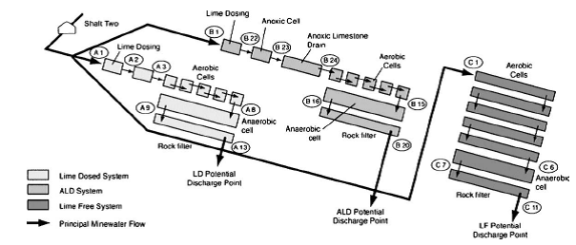
B.9-1. Wheal Jane pilot systems.
Source: Reprinted from Whitehead and Prior, 2005.
B.9.2 MIW Chemistry
Water from the Wheal Mine is extremely acidic and contaminated with high concentrations of iron, zinc cadmium and arsenic (Table B.9-1).
|
Analyte |
Influent (mg/l) |
|---|---|
|
pH |
3 |
|
Al |
12.4 |
|
As |
9 |
|
Cu |
0.1 |
|
Fe |
161 |
|
Mn |
5.3 |
|
Pb |
0.1 |
|
Zn |
41.9 |
|
Sulfate |
1094 |
B.9.3 System Design
B.9.3.1 BCR Design
Three parallel anaerobic BCRs were constructed to receive flow from a series of aerobic cells) that were designed based on USBM criteria to remove iron at low pH (see Figure 1). The maximum design flow capacity is approximately 9 GPM and can receive short term flows of up to 30 GPM. This represents less than 1% of the total mine water discharge from the Wheal Jane mine. The BCRs were operated in a downflow configuration.
The plant contained three multi-cellAn individual unit in a treatment system. treatment systems that used one of three pretreatment methods to raise pH: lime dosing to pH 5.0 with calcium carbonate (LD), an anoxic limestone drain (ALD), or a lime-free system without pretreatment (LF). Due to plugging, the ALDanoxic limestone drain system was modified to function as another lime dosing system. In each treatment system, the pre-treated drainage passed to aerobic reed bed wetlands for iron and arsenic removal. Next, water flowed through an anaerobic cell for sulfate reductionThe stripping of oxygen atoms from sulfate (SO₄²⁻), most often yielding sulfide (S²⁻) as an ultimate product. and heavy metals removal. The final stage was an aerobic rock filter, designed to promote manganese removal. (Whitehead and Prior 2005).
The anaerobic cell in each system was approximately 87.5 m long, 8.75 m wide, and 1 m deep, lined with high-density polyethylene (HDPE) membranes. This depression contained a mixture of 95% softwood sawdust, 5% hay, and a small quantity of cow manure to inoculate the bioreactor with SRB. The mixture was covered with approximately 0.4 m of earth and gravel, to maintain anaerobic conditions. (Johnson and Hallberg 2005). Pilot cells began operation in 1995, and the compost in the bioreactors was replaced in early 2000. The compost was amended with limestone and re-inoculated with manure (Guzek 2012).
B.9.4 BCR Performance
The bioreactors were constructed primarily to generate alkalinity, raise pH, and remove heavy metals, particularly zinc. The influent acid mine drainage (AMD)A low pH, metal-laden, sulfate-rich drainage originating from a mined area that occurs where sulfur or metal sulfides are exposed to atmospheric conditions. It forms under natural conditions from the oxidation of sulfide minerals and where the acidity exceeds the alkalinity. See also acid rock drainage. from the aerobic wetlands was similar for each system, with a pH between 3 and 4, and 95 to 100% dissolved oxygen saturation. Redox potential and dissolved oxygen concentrations decreased in all three bioreactors (Johnson and Hallberg 2005).
All three bioreactors increased pH, to 5.5 (LD system), 5.0 (ALDanoxic limestone drain system), and 5.9 (LF system). When discharged to the rock filters, pH decreased to 4.5 in the LD and 5.0 in the ALDanoxic limestone drain systems, while it increased to 6.8 in the LF system (Table B.9-2). Oxidation of excess sulfide and ferrous iron from the bioreactor effluent may have contributed to the downstream pH decrease (Johnson and Hallberg 2005). The low pH in the bioreactor effluent and rock filters likely contributed to the failure of manganese removal in the LD and ALDanoxic limestone drain systems (Whitehead et al. 2005).
|
|
LD |
ALD |
LF |
|||
|---|---|---|---|---|---|---|
|
Analyte |
Influent |
Effluent |
Influent |
Effluent |
Influent |
Effluent |
|
pH |
3.6 |
5.5 |
3.6 |
5 |
3.9 |
5.9 |
|
Fe |
3.8 |
17.3 |
5.8 |
12.6 |
3.6 |
0.4 |
|
Zn |
36.4 |
16.3 |
29.7 |
9.8 |
40.7 |
0.01 |
|
Sulfate |
245 |
205 |
230 |
184 |
233 |
128 |
|
ORP (mv) |
768 |
178 |
743 |
222 |
741 |
66 |
Sulfate concentrations decreased in all three bioreactors over the treatment period. During the entire monitoring period, the bioreactors lowered sulfate concentrations by 27±18% (LD), 23±12% (ALDanoxic limestone drain), and 62±20% (LF). The bioreactor in the LF system consistently removed the most sulfate. However, its efficiency decreased from 91% to 39% over the study period. In all systems, sulfate concentrations increased from bioreactor effluent concentrations in the rock filter. (Johnson and Hallberg 2005)
Like sulfate, zinc was removed in all bioreactors, though the LF system bioreactor had the greatest removal rate (Table 2). Based on September 2002 measurements, the bioreactors removed 55% (LD), 67% (ALDanoxic limestone drain), and 99% (LF) of soluble zinc. Dissolved zinc concentrations increased in the rock filter in the ALDanoxic limestone drain system, but decreased in the other systems (Johnson and Hallberg 2005). However, data collected from March 2000 to February 2002 showed removal rates over 99% for the LD system (Table 3; Whitehead 2006).
Though much soluble iron was removed in the pretreatment and aerobic cells, concentrations continued to change in the anaerobic bioreactors. Soluble iron in the LD and ALDanoxic limestone drain bioreactor effluent was more than twice the influent (Table 2). Soluble iron decreased within the LF system bioreactor and generally remained low. All three complete treatment systems ultimately lowered soluble iron concentrations by at least an order of magnitude. (Johnson and Hallberg 2005)
Though excess sulfide was produced in all three bioreactors, it did not effectively form iron sulfide precipitates in two bioreactors, apparently due to the low pH. Furthermore, ferric iron minerals entered the bioreactors and were reducedIn chemistry, having gained electrons. Often gaining electrons is accompanied with gaining protons (hydrogen). As an example, when O₂ reacts with H₂, the oxygen is reduced, forming H₂O. to soluble ferrous iron, increasing dissolved iron within two of the bioreactors. Sulfides and ferrous iron exported in the bioreactor effluent were then oxidized to sulfate and ferric iron, increasing acidity downstream. (Johnson and Hallberg 2005)
Pilot cells began operation in 1995, and the compost in the bioreactors was replaced in early 2000 to improve performance in raising pH and removing metals. A number of conditions combined to overwhelm the BCR cell receiving the effluent from the aerobic cells. First, the aerobic cells were not as efficient as expected in neutralizing mineral acidity, and rainfall dilution did not significantly affect the mineral acidity of the water, a critical design parameter for BCR cells. Second, overloading occurred during the winter when bacterial activity was apparently stressed already due to the low water and air temperatures. Third, and lastly, the initial organic substrateEither (a) a chemical which reacts or (b) a solid surface or (c) an electron donor. did not contain any inherent buffering capacity (bench-scale tests had not been performed due to schedule restrictions). In summary, the stressed organisms were hit with an acidity overload and there was no self-buffering component in the substrate to counter it. Consequently, the metal removal performance of the cell suffered. Fortunately, this was a pilot test, and the situation was corrected by excavating the anaerobic substrate, amending it with limestone, re-inoculating with manure, and installing a flow restriction device (orifice) on the aerobic cell outfall that helped to manage the flow peaks. The cell responded favorably and was subsequently more successful at zinc (and iron) removal.
Elimination of flow into the lime free system improved performance of the anaerobic cell. The LF system was shut down due to a fracture in the main influent pipe between 2000 and June 2001. During this time, flow was shut off to the lime free system. Upon recommencement of mine water flow, it was noticed that the effluent from the anaerobic cell had a different chemistry from the effluent of the other two cells which continued to receive flow. The pH of the discharge from the lime free cell was in the range of pH 6-7 as opposed to pH 4-5 for the other two anaerobic cells. Metal removal efficiency was also higher in the lime free cell. The shutdown possibly eliminated stresses to the population caused by low pH water which allowed the development of a more robust microbiological population that produced alkalinity, raising the pH and more efficiently removing metals.
B.9.5 Challenges and Lessons Learned
Johnson and Hallberg (2005) attribute the poor performance of the anaerobic cells to the following factors:
- Acidic, oxygenated water entering the bioreactors created suboptimal conditions for SRB growth.
- SRB populations were unable to tolerate the acidity of the system. A ten-month shutdown of the LF system may have allowed more tolerant microbial populations to develop and flourish in the anaerobic cell.
- Refurbishing the substrate with limestone increased the pH which was beneficial to the micro-organism community (Guzek 2012).
- Soluble and particulate ferric iron entering the bioreactors exceeded the capacity of the system to reduce and precipitate iron, particularly under low-pH conditions.
- Collection of rainwater in aerobic cells added unnecessarily to the flow entering the bioreactors.
B.9.6 References
Johnson, D.B. and K.B. Hallberg, 2005. Biogeochemistry of the compost bioreactor components of a composite acid mine drainage passive remediation system. Science of the Total Environment, 338:15-21.
Brown, M., B. Barley, H. Wood, 2002. Mine Water Treatment-Technology Application and Policy. IWA Publishing.
Whitehead, P.G. and H. Prior, 2005. Bioremediation of acid mine drainage; an introduction to the Wheal Jane wetlands project. Science of the Total Environment 338:15-21.
Gusek, Jim, 2012, Personal Communication
B.9.7 Other Resources
Brown, Melanie E. et al. 2003. Passive mine water treatment-practical implications, Mining Environmental Management, May 2003
Hallett, Clive, R. Coulton, C. Marsden, 2003. “A Clear Success” In: Mining Environmental Management, May 2003, pp. 10-12.
Mine Water Treatment at Wheal Jane Tin Mine, Cornwall, Case Study Bulletin, CL:AIRE publications, March, 2004
Doshi, Shelia, 2006, Bioremediation of Acid Mine Drainage Using Sulfate Reducing Bacteria, U.S. Environmental Protection Agency, Office of Solid Waste and Emergency Response.
Hallberg, K.B. and D.B. Johnson, 2003. Passive mine water treatment at the former Wheal Jane Tin Mine, Cornwall: important biogeochemical and microbiological lessons. Land Contamination and Reclamation, 11(2):213-220.
Publication Date: November 2013